


The Finger As A Gauge: The Tactile Pre-Inspection Method For Drywall Joint Paper Tape Seams
Leave a message
On the path to achieving flawlessly seamless walls, whether a joint will ultimately become visible under light is the true test of craftsmanship. Traditional side-lighting inspection, while direct, is a reactive verification. Is there a method to foresee potential flaws before the final coat, during the mid-stage of construction? The answer lies in the fingertips of every skilled artisan. This article details an advanced technique known as the "Tactile Probe" method-it forsakes reliance on sight, instead transforming the finger into a micron-level detection tool, providing the ultimate assurance for perfect seams with drywall joint paper tape.
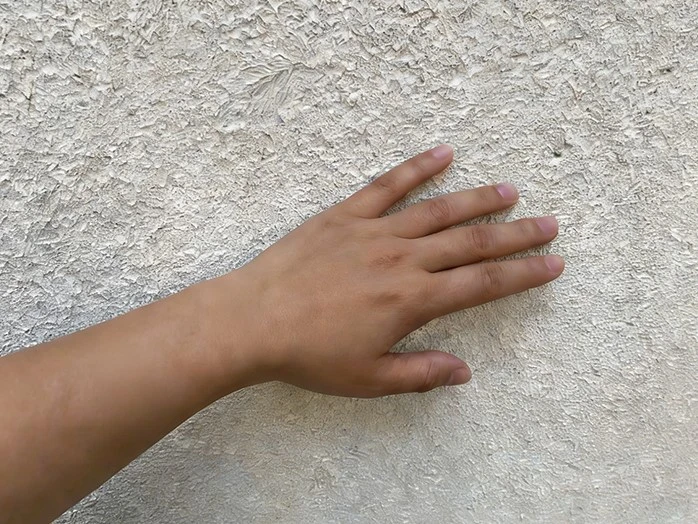
From "Seeing" to "Sensing"
The Inherent Lag of Visual Inspection: Relying on strong raking light to find imperfections is essentially a final judgment passed after all coating layers are complete. Repair at this stage often means sanding might damage the primer, and patching can lead to color mismatch-costly and rarely perfect.
The Microscopic Advantage of Touch: After the joint compound has "skinned over" (surface set but not fully cured), any potential undulations are already formed. The human fingertip, particularly the side of the finger pad, can ideally discern height differences as minute as 0.01 millimeters, far surpassing the naked eye's ability to detect initial flaws under uniform light. This provides a unique "window of opportunity" for early intervention.
The "Tactile Probe" Method
The core of this method is establishing a repeatable, verifiable procedure for standardized perception.
- Optimal Timing: After the first or a critical layer of joint compound has fully skinned over, but before any sanding or the next coat is applied.
- Environmental Prep: Ensure the seam area is clean and dust-free. Fingers should be dry and clean.
- Core Operation (Blind Scanning):
- Eliminate Vision: Close your eyes completely. This removes visual interference, forcing the brain to focus solely on processing tactile signals.
- Engage the Sensor: Use the side of your index or middle finger pad. Apply near-zero pressure (just the finger's own weight) to touch the original wall surface next to the seam.
- Ultra-Slow Scan: Move at an extremely slow, consistent speed (about 1-2 cm per second) over the centerline of the seam and at least 5 cm on either side. The slower the speed, the higher the perceptual resolution.
4. Signal Interpretation & Marking:
- Focus on detecting the slightest "ridge" (a raised obstruction), "dip" (a sinking drop-off), or subtle break in texture.
- Upon detecting an anomaly, immediately open your eyes and mark the spot with an erasable pencil, transforming subjective perception into an objective repair coordinate.
From Pre-Inspection to Precision Correction
The value of detection lies in guiding action, forming a complete "predict-repair" cycle.
1. Tiered Correction Strategy:
- Micro Ridges: During subsequent sanding, use a higher-grit sandpaper for localized, refined leveling.
- Noticeable Dips: Apply a thin layer of joint compound locally to the marked area. Once dry, sand lightly to achieve a fill.
- Corrections at this stage consume far less material and time than a full-scale repair on the finished surface.
2. Summary of Process Advantages:
- Proactive & Predictive: Eliminates problems before layers build up, shifting from passive acceptance to active control.
- Cost-Effective & Efficient: Dramatically reduces the cost of later rework and preserves the value of previous work stages.
- A Guarantee of Excellence: This is the foundational process for achieving the top-tier goal of the "invisible seam." It ensures the absolute flatness of the substrate built by the drywall joint paper tape, laying a perfect foundation for any high-end finish.
Redefining the Artisan's Perceptive Dimension
"Using the finger as a gauge" is more than a technique; it is a philosophy of craftsmanship. It marks the artisan's evolution from a mere manual worker to a "wall doctor" capable of conversing with materials and perceiving the microscopic world. By recalibrating and trusting their biological senses, craftsmen internalize quality control, making it an innate ability rather than one dependent on external devices.
In the realm of precision finishing, the most advanced inspection instrument is often the trained human body itself. Mastering the tactile pre-inspection method for drywall joint paper tape means you understand not only the material's application but also the very logic of creating a perfect seam. When the measure of the fingertip and the focus of the mind become one, what is ultimately presented in silence under light is an impeccable, absolute plane.
If you have any questions or need assistance, please feel free to contact us:
Office: +86-21-66037922
+86-21-66037926
Email: sales@galaxy-fiber.com
Mobile: +86-18721503790
GALAXYFIBER


