


What Are The Key Evaluation Points For The Installation Process Of Corner Metal Tape?
Leave a message
Applied to construction environments
After completing the static acceptance of corner metal tape bulk samples, applying it in a simulated or actual construction environment is the final step in evaluating its design rationality and construction-friendliness. The following key experience points will help you determine whether the product can genuinely enhance on-site efficiency and the quality of the final project.
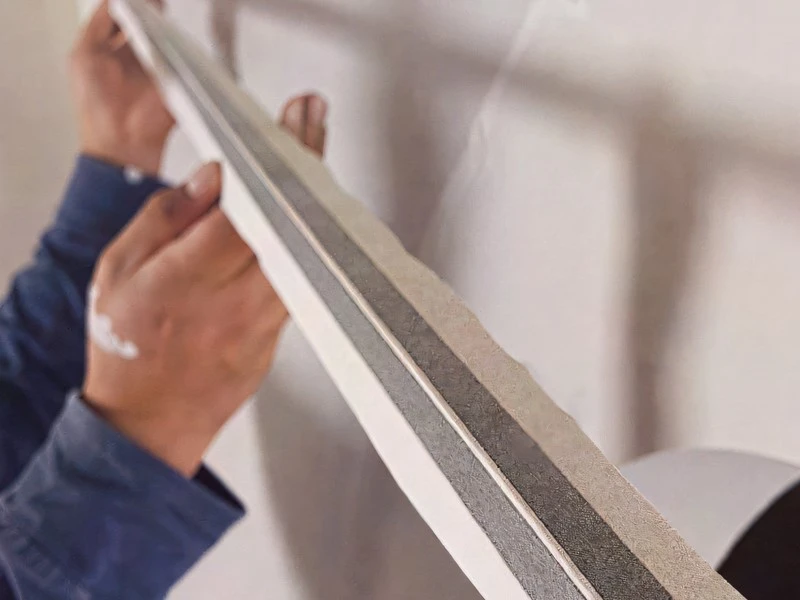
Anchor Hole Design Test
The core purpose of hole or mesh design is to allow mortar/putty to effectively penetrate and form physical "anchor bolts," which is key to preventing later cracking.
Operation and Evaluation:
- Extrusion Test: Apply a suitable amount of mortar on a test baseboard (e.g., drywall) and press the metal corner tape onto it. Observe the state of the mortar extruding from the holes. The ideal scenario is smooth, uniform extrusion, forming continuous, well-defined "mushroom heads."
- Resistance Perception: Feel the resistance during the pressing process. The resistance should be moderate: too little resistance may indicate overly large holes or overly thin mortar, resulting in weak anchoring force; too much resistance may mean the holes are prone to clogging, making construction laborious and filling incomplete. You can record the approximate force required to achieve effective pressing.
- Design Inspection: Check the size, density, and distribution uniformity of the holes. Too dense will weaken the product's own strength, too sparse will provide insufficient anchor points.
Temporary Fixation Experience
Before the final plaster coating, whether the corner tape can be quickly and stably preliminarily fixed directly affects installation speed and accuracy.
Operation and Evaluation:
- Initial Tack of Adhesive: If using quick-setting adhesive, test its open time and initial tack. After pasting, the product should maintain its position for 1-2 minutes, allowing you to make fine adjustments, but not slip immediately.
- Convenience of Mechanical Fixation: If the design allows for temporary fixation with nails, test the width and toughness of its flanges. Nails should be driven in easily and held securely without causing the material to crack or fix loosely. You can try fixing it on a vertical corner to observe if it slips due to its own weight.
- Comprehensive Evaluation: This experience directly relates to your team's installation time per point and fatigue level.
Compatibility Test with Laser Levels
Laser levels are essential tools for ensuring straight and level installation. The product surface should not interfere with their use.
Operation and Evaluation:
- Glare Test: Project the laser line onto the surface of the metal reinforced corner tape under normal indoor lighting.
- Problem Identification: If the surface is too shiny or mirror-like, the laser line will reflect severely, scatter, or appear glaringly blurred, preventing you from aligning precisely.
- Ideal State: The surface should have a matte or fine sandblasted texture. The laser line projected onto it should appear clear and sharp without causing distracting glare, allowing you and your team to calibrate quickly.
Plaster Layer Adhesion Test
Whether the plaster material adheres firmly is fundamental to avoiding hollowing and peeling, which is directly related to the surface treatment process of the corner tape.
Operation and Evaluation:
- Initial Adhesion Observation: Apply mortar or putty to the product surface. Observe whether it spreads easily and adheres or tends to slide off in clumps or show water-film separation (repellency).
- Construction Feel: Feel with your hand or trowel whether the material can be compacted onto the surface easily.
- Process Judgment: Check if the surface has undergone roughening, micro-porous treatment, or has a coating that enhances adhesion. Compared to a shiny bare metal surface, a treated surface should demonstrate significantly better adhesion.
Comprehensive Installation Experience Conclusion & Suggestion
It is recommended that you or your construction team systematically record the operation time, effort level, and problems encountered in each of the above steps under conditions simulating real application. An excellent corner metal tape should demonstrate a comprehensive experience of smooth, labor-saving, and controllable results throughout this process, thereby significantly improving the efficiency and quality reliability of the overall project.
If you have any questions or need assistance, please feel free to contact us:
Office: +86-21-66037922
+86-21-66037926
Email: sales@galaxy-fiber.com
Mobile: +86-18721503790
GALAXYFIBER


